Beginner Rigid Heddle
With Myra Chang Thompson and Ray Taylor
Two-Day Workshop
If you have zero weaving experience, this is the workshop for you! This workshop will introduce you to direct warping (dressing the loom), the use of the loom with special attention to the creation of cloth that is designed to be a scarf, securing the edges, finishing the scarf and future care of the scarf.
Everything you need to learn, from choosing yarns to warping to weaving to finishing your handwoven scarf.
In this workshop, you will…
- learn essential weaving terminology (finally figure out the difference between warp and weft!)
- warp your loom from start to finish.
- choose the right yarn for your project.
- weave a beautiful and unique scarf with all of the finishing touches.
Buy, Bring, or Rent A Loom for This Workshop
We offer a good selection of top-quality looms for purchase. Begin your weaving journey with a loom of your own! Contact us for more information
If you already have the appropriate loom, please bring that to the workshop.
We also offer a limited number of looms you can rent on-site during this workshop.
Click here to see the looms you can rent for this workshop
Please select the loom you’d like to rent and add it to your cart before clicking the “Register” button.


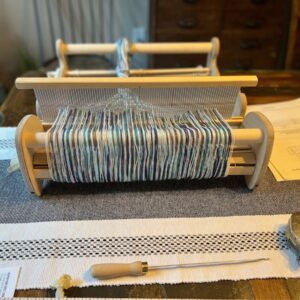
16″ Ashford Rigid Heddle Loom
8 dent reed, 2 table clamps, 2 stick shuttles, 1 warping peg
$30.00Read more
- Skill level Beginner
- Age appropriate 16+ (minors must have a parent on site)
- Materials fee $15 (includes complete handout with detailed instructions and references, all yarns needed to weave a scarf, and tools and supplies for weaving during the workshop)
- Students should bring
a loom, scissors, tape measurer, a belt shuttle, lunch, a drink, and note-taking materials.
Instructors

 Myra Chang Thompson
Myra was born in Northern New Mexico. Embroidery, crochet and clothing construction were taught by her mother and practiced throughout most of her life. Myra is a professional teacher with 35 years of classroom experience. Early in her marriage, she was given a 4 shaft loom by her husband, Bill. She was a member of the Stockton Weavers Guild in California. She refined her weaving skills under the watchful eye of E. E. Gilmore of Gilmore Looms. Her passion for weaving and teaching grew over the years. During Myra’s time in the Weavers Guild of Boston, her technical skills were honed. Upon returning to New Mexico, she joined Las Arañas Spinners and Weavers Guild and Fiber to Finish Guild in Valencia County. A long time member of Handweavers Guild of America, Myra attends and teaches at Convergence, the biennial fiber arts conference. She also teaches locally, regionally and nationally.
 Ray Taylor
Ray was born in the rural Catskill region of upstate New York. Early exposure to fiber arts came through his mother’s quilting and sewing, as well as participation in 4-H, where foundational handcraft skills were first cultivated. These interests were rekindled in 2021 after encountering New Mexico’s deeply rooted textile traditions.
Upon joining the Las Arañas Spinners and Weavers Guild, Ray met Myra Chang Thompson, who provided sustained mentorship, private instruction, and encouragement. For his first several years of focused study, Ray worked exclusively on the rigid heddle loom, exploring its structural and expressive range. He studied in workshops with Sedona Rigsby and Liz Gipson, while continuing mentorship with Chang Thompson. His technical and conceptual development has also been informed by the writings of Betty Davenport, Jane Patrick, and Petra Marciniak.
More recently, Ray has expanded his practice to include inkle weaving under Annie MacHale and tapestry study with Sara Goldenberg White. He facilitates a monthly rigid heddle study group, continually pushing the structural possibilities of what is often considered a modest loom. His projects have included wall hangings, rugs, and sabanilla cloth intended for colcha embroidery.
Prior to retirement, Ray’s professional life centered on recruiting, developing, and mentoring talent. Guiding others as they discover weaving—and the satisfaction inherent in disciplined craft—has proven a natural continuation of that work.